
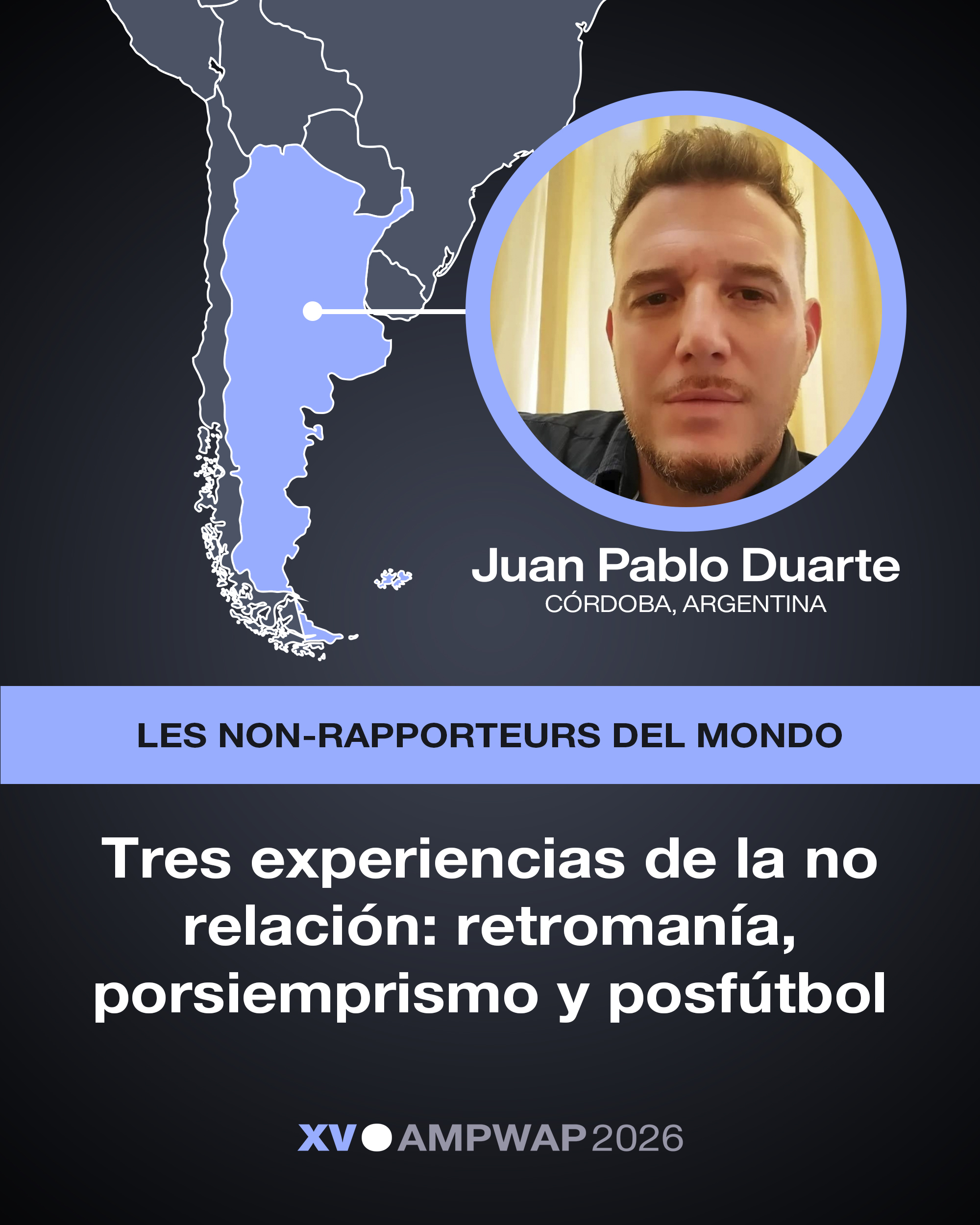
Touring the fan club of a football team, reliving the intensity of an old rock band's hit as a museum piece, or immersing yourself in an electronic music festival, all refer to an experience economy that offers memorable events which do not require belonging or prior knowledge. But these are not just acts of consumption; they are secular ways of accessing something of that oceanic feeling that Romain Rolland described to Freud. Today, the search for that feeling of limitless unity with the world is given such peculiar names as retromania, foreverism and post-football.
In Argentina, four out of ten people take out loans to attend concerts by bands such as Oasis, Guns n' Roses or AC/DC, shows that the press often describe as the last "collective emotional refuge". 1 But these are also the kinds of events in which Simon Reynolds identified the signs of an addiction to reliving the past that dilutes the enthusiasm for current creations: retromania.2
Proust wrote that, as long as it is intended to suggest a new truth, the power of repetition may be preferable to that of artificial innovation.3 But Grafton Tanner saw something different in the current impulse to prolong and revitalise cultural objects, calling it foreverism.4
In addition to the opportunity for ritual, offered by this eternal return of the retro, there is a new experience associated with the way of living and understanding football, which is separate from love for a club or territorial roots. It is a new type of bond, in which the devotion to a player can transcend belonging to a team: the post-football era.5,6
Post-football, foreverism and retromania give rise to experiences that go hand in hand with the inexistence of the Other and can subsist without producing shared knowledge or community ties, and which don't demand the acceptance of the imposition of traditions. These are experiences typical of a culture of spare parts, whose marks—as Jacques-Alain Miller suggests—must be situated at the level of the speaking-being and the body, in the register of the jouissance of the non-relation.7 In this sense, these could be marks that perhaps cannot be reduced to significantisation or the mere act of consumption, and which therefore claim for new names.
[1] Crónica, "Los jóvenes se endeudan cada vez más para ir a recitales: Se valora más el presente que la planificación" [Young people are getting into more and more debt to go to concerts: The present is valued more than planning], 16 August 2025. Available online: Cronica.
[2] Reynolds, S. Retromanía. La adicción del pop a su propio pasado [Retromania. Pop's Addiction to Its Own Past], Buenos Aires, Caja Negra, 2012.
[3] Proust, M., "In the Shadow of Young Girls in Flower," In Search of Lost Time, Vol. 2, Penguin Classics, 2003.
[4] Tanner, G. Porsiemprismo. Cuando nada termina nunca [Foreverism. When Nothing Ever Ends], Buenos Aires, Caja Negra, 2024.
[5] Torres, A. "Que no lo llamen fútbol" [Don't Call It Football], Panenka, no. 71, Spain, 2018, pp. 30–33. Available online: Panenka.
[6] Meneses, J. P. "Juan Pablo Meneses: por qué el fútbol ha muerto y ya no se celebran los goles" [Why football has died, and goals are no longer celebrated], BBC News Mundo, 23 July 2021. Available online: BBC.
[7] Miller, J.-A., La experiencia de lo real en la cura psicoanalítica [The Experience of the Real in Psychoanalytic Treatment], Buenos Aires, Paidós, 2011.
